
Learn how to calculate your target heart rate for safe, effective exercise.
Your target heart rate for exercise is one of the most important tools for getting the most out of your workouts. By exercising within your target heart rate zone, you can safely improve heart health, boost brain function, and increase overall fitness. Aerobic exercise — such as walking, swimming, cycling, or dancing — works best when you stay in the right range. Understanding your target heart rate for exercise not only helps you maximize results but also lowers your risk of burnout and injury.
If you are just starting to do aerobic exercise, aim for moderate intensity activities, which is about 50-70% of your maximum heart rate (maxHR), or the low end of your THR. As you get stronger, aim for vigorous physical activities, which is about 70-85% maxHR, or the high end of your THR.
Below is a chart to help you determine your target heart rate based on your age. The age-predicted maximum heart rate is calculated by subtracting your age from 220, and the THR is 50-85% of the maxHR. If you want to know your individual maximum and target heart rates, you would need to complete an exercise stress test or consult your doctor, as there are multiple factors that would affect it such as health history and fitness levels.
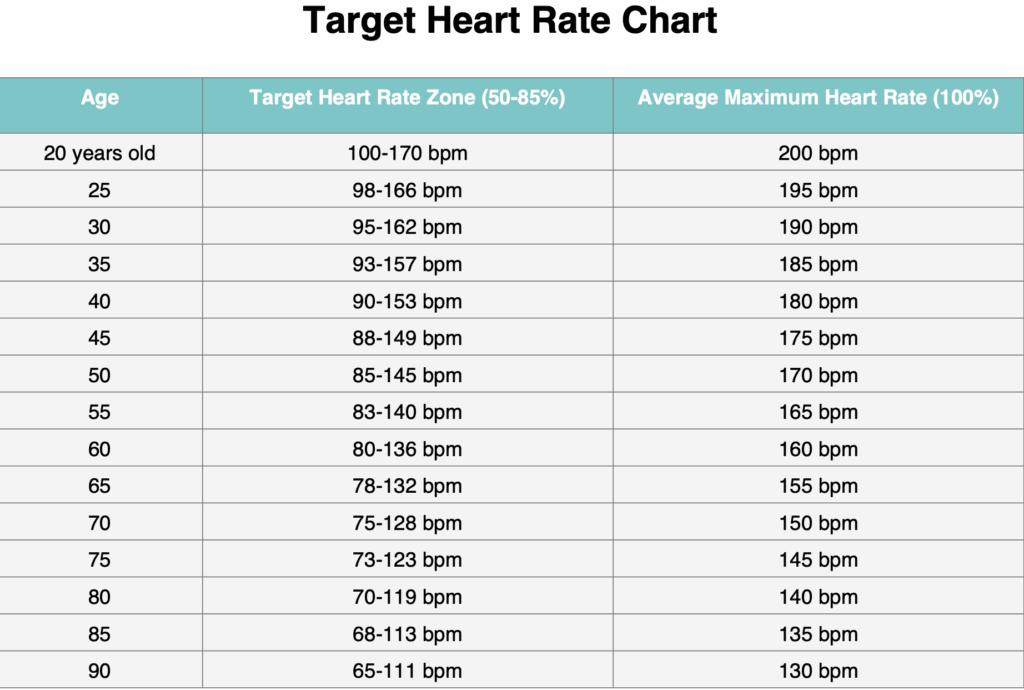
Once you know your maxHR and THR, you can calculate it in a few ways. You can wear a heart rate monitor or a smartwatch that has a heart rate monitor. Another easy way to measure your heart rate is to place your index and middle finger on your wrist below your thumb and count how many times you feel a pulse in 15 seconds, then multiply that number by 4.
The Talk Test: An Easy Way to Measure Target Heart Rate for Exercise
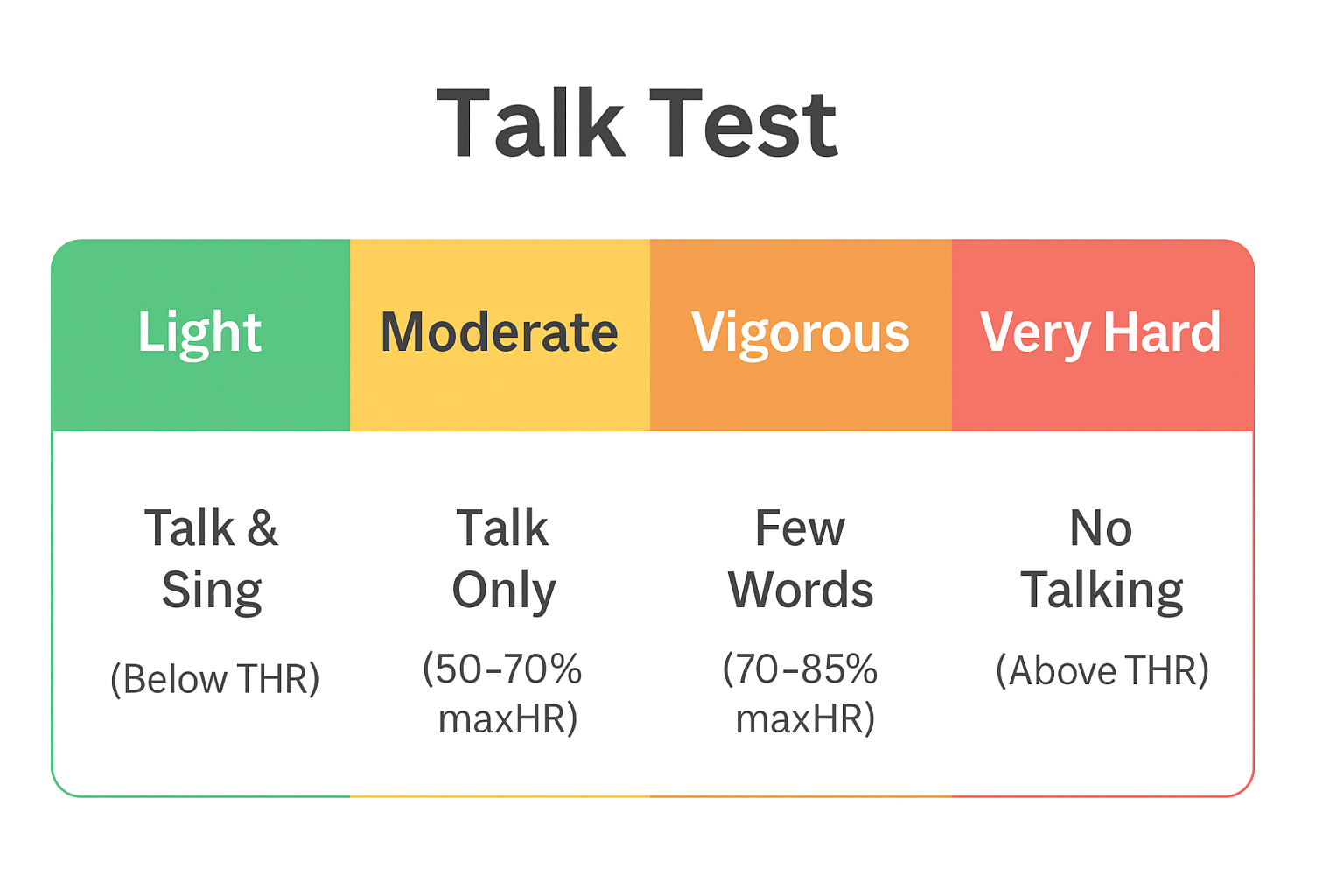
Another simple, no‑equipment way to gauge whether you’re exercising within your target heart rate zone is the talk test. During moderate‑intensity activity (around 50–70% of your maxHR), you should be able to carry on a conversation but not sing. At vigorous intensity (about 70–85% of your maxHR), you’ll only be able to say a few words at a time before needing to pause for breath. If you can’t talk at all, you’re likely exercising above your target zone and may need to ease up. This method is recognized by public health authorities as a valid and practical way to assess exercise intensity.
Understanding your target heart rate and using simple tools like the talk test can help you exercise safely and effectively. If you’re recovering from a concussion, managing lingering symptoms, or want personalized guidance on building a safe exercise plan, our team at NCX Brain Recovery is here to help. We offer a free 30-minute consultation with one of our neuro-occupational therapists to answer your questions and guide you toward the next steps in your recovery. Schedule your free consultation today.
Works cited:
- American Heart Association. (2021) Target heart rate chart. Available from: https://www.heart.org/en/healthy-living/fitness/fitness-basics/target-heart-rates
- Mellett, L. H., & Bousquet, G. (2013). Heart-healthy exercise. Circulation, 127(17), e571-e572. Available from: https://www.ahajournals.org/doi/full/10.1161/CIRCULATIONAHA.112.000880
- Penn Medicine. (2018) Exercise target heart rate: what you should know. Available from: https://www.pennmedicine.org/updates/blogs/heart-and-vascular-blog/2018/march/exercise-target-heart-rate
- University of Iowa Health Care. (2023) Target heart rate for exercise. Available from: https://uihc.org/health-topics/target-heart-rate-exercise#:~:text=It%20is%20the%20level%20at,220%20and%20subtract%20your%20age.&text=Sustaining%20a%20workout%20at%20this,helps%20you%20pace%20your%20workouts.
- CDC, Measuring Physical Activity. (2022) Talk Test. Available from:
https://www.cdc.gov/physicalactivity/basics/measuring/index.html?utm_source=chatgpt.com