
Why do headaches linger after a concussion? A concussion can affect several systems at once: how the brain manages energy and blood flow, the nervous system’s stress response, how the eyes work together, and the upper neck. Each can cause its own kind of headache, and many people have more than one. If yours haven’t eased by about a month, it’s worth getting evaluated.
Clinically reviewed by Blake Urednick, MOT, OTR/L, Clinical Director, NCX Brain Recovery
Jump to: Why location matters | Migraine-type | Tension/autonomic | Vision-related | Neck-related | More than one pattern | Cognitive fatigue | Daily habits | When to get help | Treatment at NCX | FAQ
When someone tells us about a headache that hasn’t let up since their concussion, one of the first things we ask is simple: where is it? Is it a band around the whole head, a throb behind one eye, an ache across the forehead that builds while reading, or a knot at the base of the skull?
The answer matters more than most people expect. Often, where a headache sits and how it behaves points to what’s driving it, and different drivers respond to different kinds of care. That’s part of why the same headache medicine can help one person and barely touch the next.
Lingering headaches are also more common than many people realize, and not only after hard hits. Research has found that long-lasting headaches show up more often after mild brain injuries than after moderate or severe ones. A “mild” concussion doesn’t always mean mild aftereffects, and a headache that sticks around usually has a reason behind it that can be found and worked on.
When a headache needs emergency care: go to the ER or call 911 for a sudden, severe headache unlike any you’ve had; a headache that keeps building and nothing helps; repeated vomiting; growing confusion, agitation, or sleepiness; slurred speech, weakness, numbness, or clumsiness; a seizure; pupils of different sizes; or a new headache after another blow to the head.
Why Does Where a Headache Sits Matter?
A concussion isn’t a single injury to a single spot. The same sudden force can affect several systems at once: the brain’s own energy and blood-flow regulation, the nervous system that manages your stress response, the visual system that keeps your eyes working as a team, and the joints and muscles of the upper neck. Each of those systems can produce a headache, and each one tends to leave a slightly different fingerprint.
Concussion researchers have organized lingering symptoms along these same lines, sorting them into problems that come from the brain’s physiology, from the vision and balance systems, or from the neck. Each group responds to different kinds of treatment. There’s an important catch, though. One study found that symptoms alone couldn’t reliably tell a brain-driven problem apart from a neck- or balance-driven one. The researchers concluded that a hands-on examination is what actually sorts it out.
So think of the patterns below as clues, not a diagnosis. Some of the common patterns are:
- Migraine-type: throbbing, often one-sided, with light and sound sensitivity
- Tension/autonomic: a band of pressure around the head
- Vision-related: at the forehead, the base of the skull, or moving between the two, and tied to reading and screens
- Neck-related (cervicogenic): anchored at the base of the skull and tied to neck position
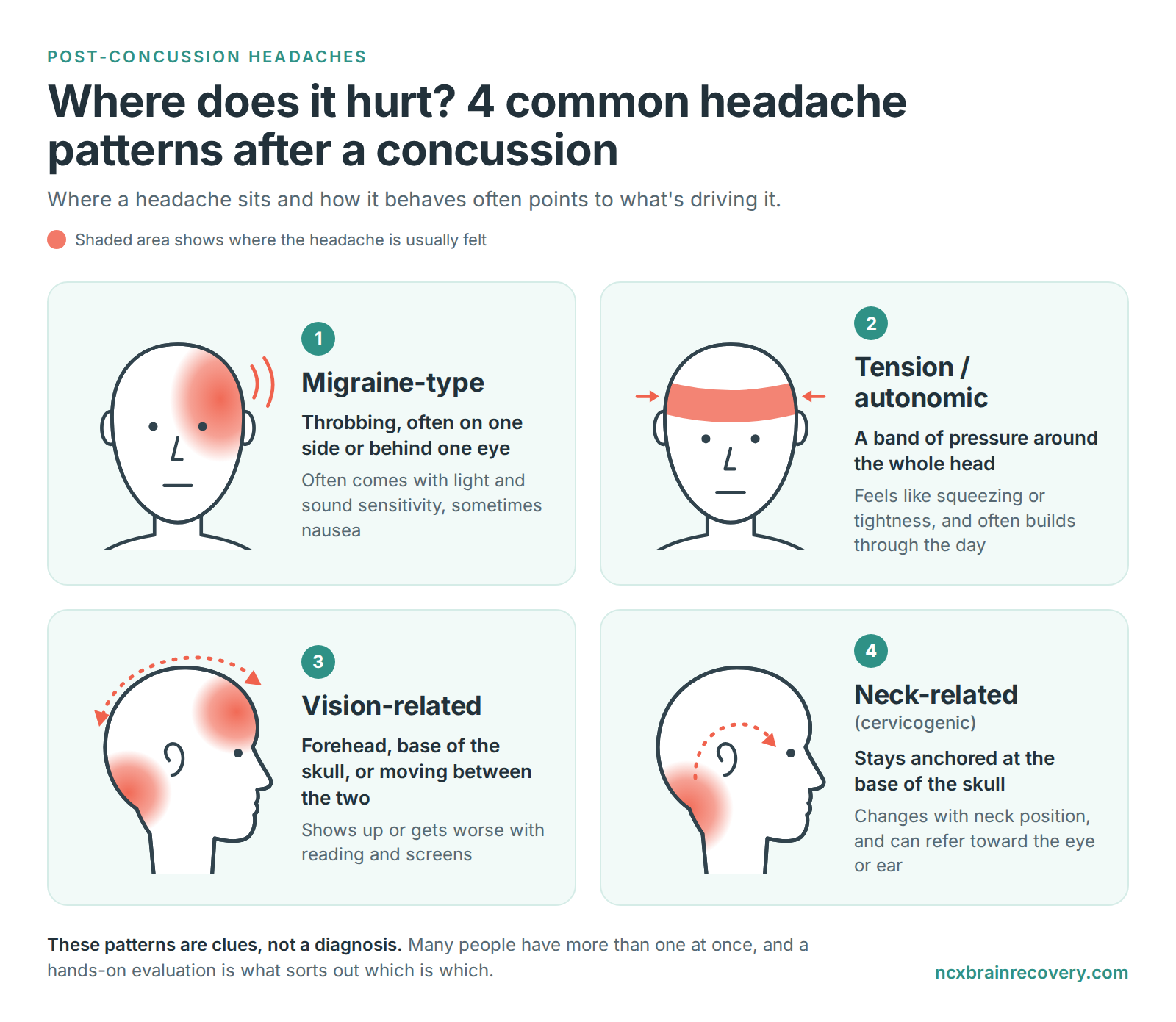
1. Migraine-Type Headaches
What it can feel like: a throbbing or pulsing pain, often on one side of the head, around the temple, or behind one eye. It often comes with sensitivity to light and sound, and sometimes nausea. Many people also notice dizziness or a queasy, off-balance feeling with movement. Physical activity or a busy, bright environment can make it worse while it’s happening.
What’s often behind it: Migraine-like headaches are the most common pattern researchers find in people whose headaches linger after a concussion. In recent studies, most people with ongoing post-concussion headaches had migraine features. This happens even to people who have never had a migraine in their lives and have no family history of them.
There’s real biology behind it. Right after a concussion, brain cells go through a period where their energy demand outpaces their energy supply. Researchers have linked that chemical shake-up to the migraine-like symptoms many people experience. In short, the injury can make the brain’s pain and sensory-processing networks more reactive than they were before. That’s why lights, noise, and busy environments hit harder than they used to. In research on lingering post-concussion headaches, stress, poor sleep, and bright light come up as some of the most common triggers.
What can help:
- Track your patterns. Note headache days alongside sleep, meals, water, screen time, and busy environments. Triggers that feel random often turn out to have a rhythm.
- Keep your days steady. Regular sleep and wake times, regular meals, and plenty of water give a sensitive brain fewer surprises to react to.
- Take the edge off light without living in the dark. Dimming screens and wearing a hat or sunglasses outdoors can help in the short term. The goal is to gradually build tolerance back, not to shut light out all day.
- Ask your doctor about migraine-specific options. Recent research suggests that treatments designed for migraine are often underused in people with post-concussion headaches, so it’s worth asking about them.
When dizziness or motion sensitivity comes along with this pattern, it’s often a sign that the balance system is part of the picture too. That’s where vestibular retraining can make a real difference.
2. Tension/Autonomic Headaches
What it can feel like: pressure or tightness rather than throbbing. People describe it as a band wrapped around the head, a squeeze, or a balloon slowly inflating inside the skull. It usually shows up on both sides and usually doesn’t come with nausea, which helps set it apart from a migraine-type headache. It often builds as the day goes on, especially with stress, noisy or crowded places, or long stretches of mental effort.
What’s often behind it: Your autonomic nervous system is the automatic system that runs your heart rate, breathing, blood pressure, and stress response in the background. It works like a gas pedal and a brake. After a concussion, that system can get stuck with the gas pedal pressed down, keeping the body in a low-grade state of high alert even when nothing is wrong. The same dysregulation can also disrupt sleep, which we cover in our sleep guide for concussion recovery.
Blood flow is part of this too. Normally, when one area of your brain gets busy, blood flow to that area adjusts almost instantly to match. After a concussion, that matching process (known as neurovascular coupling) can lag behind. The result is that a demanding afternoon costs your brain more than it should, and pressure builds as the day goes on. This stuck-on, keyed-up feeling can also look a lot like anxiety, which is one reason concussion is sometimes misdiagnosed as anxiety.
What can help:
- Slow, easy breathing with a longer exhale. A few minutes, a few times a day, is one of the simplest ways to signal the nervous system that it’s safe to ease off the gas.
- Light aerobic movement. Walking or an easy stationary bike, kept at a level that doesn’t spike your symptoms, supports nervous system regulation and overall recovery.
- Pace your day. Short breaks before the pressure builds tend to work better than pushing until it forces you to stop.
- Protect your sleep routine. A consistent wind-down and wake time gives the nervous system a predictable rhythm to settle into.
3. Vision-Related Headaches
What it can feel like: a dull ache or pressure across the forehead or brow, behind the eyes, or at the base of the skull. Sometimes it’s in both places, or it moves from the front to the back. The clearest clue is the trigger: it shows up or gets worse with reading, screens, scrolling, or other close-up work, and it often eases once you step away. It may come with eye strain, blurry or double vision, trouble reading, or losing your place on the page.
What’s often behind it: Seeing clearly up close depends on two skills most of us never think about. The first is teaming, where both eyes turn inward together to stay aimed at the same point. The second is focusing, where the eyes shift clarity between near and far. Both skills rely on the brain, and a concussion can throw them off. When that happens, the visual system has to work overtime just to keep words steady on a page, and that extra effort can show up as a headache.
Eye-teaming problems are one of the more common vision issues after a concussion. Research has linked them to higher symptom levels and more trouble with thinking tasks. This pattern often gets labeled a “tension headache” because the ache can feel similar, but the tie to visual work is what gives it away. We go deeper on this in our post on vision problems after concussion.
What can help:
- Work in shorter visual blocks. Break up reading and screen time, and look at something across the room during breaks to give your eyes a reset.
- Make the page easier on your eyes. Bigger text, less glare, lower screen brightness, and paper instead of screens when possible all reduce the workload.
- Go easy on fast scrolling and busy video. Quick visual motion asks the eyes and brain to do a lot of work at once.
- Ask about a functional vision assessment. A standard eye exam checks how sharply you see, but it doesn’t always test how well your eyes team and focus together. Those are the skills a concussion tends to affect.
4. Neck-Related (Cervicogenic) Headaches
What it can feel like: an ache that starts at the base of the skull and stays anchored there, rather than traveling to the forehead. It’s often worse on one side. Because the top joints of the neck share nerve pathways with the head, the pain can refer outward. It may reach up behind the eye, over the top of the head, or around toward the ear, a pattern some clinicians describe as a “ram’s horn.” It tends to get worse with certain neck positions or with holding one posture for a long time, like looking down at a phone, working at a desk, or driving. Neck stiffness often comes along with it.
What’s often behind it: The same sudden force that causes a concussion also whips the head and neck, so a neck injury and a concussion often happen in the same moment. The upper neck also constantly reports head position to your brain’s balance system. That’s why a neck-driven problem can bring dizziness and fog along with the headache. We walk through that overlap in our post on concussion after a car accident.
Research shows neck involvement is common in people with lingering post-concussion symptoms, and recovery tends to take longer when it isn’t addressed. There’s no single test that confirms it, which is why a careful, hands-on evaluation matters. The upside is that once the neck is identified as part of the picture, it’s a very workable piece to treat.
What can help:
- Gentle neck movement. Slow, easy range of motion within a comfortable range keeps things from stiffening up.
- Posture breaks. Bring screens up closer to eye level and change positions often, rather than holding one posture for hours.
- Heat. A warm compress on the neck and shoulders can ease tight muscles.
- Hands-on care. Soft-tissue work from a provider who understands both the neck and concussion can address what stretching alone can’t.
What If More Than One Pattern Fits?
That’s common, not the exception. Research on lingering post-concussion headaches regularly finds people with a mix of migraine-type and tension-type features. The patterns also feed each other. Hunching over a book to keep the words steady strains the neck. A nervous system stuck on high alert makes the brain more sensitive to light. A rough night of sleep lowers the threshold for all of it.
This overlap is a big reason headache relief can feel temporary. A pain reliever can take the edge off for a few hours, but it doesn’t retrain eyes that are struggling to team, calm a nervous system that’s stuck on high alert, or loosen a neck that’s feeding pain upward. Once whatever is driving the headache gets addressed, relief tends to last.
One more thing worth knowing: taking pain relievers very frequently can sometimes lead to “rebound” headaches, also called medication-overuse headache. Researchers see this often in people with lingering post-concussion headaches. If you’re reaching for pain relievers most days, bring it up with your doctor. It’s a common, fixable piece of the puzzle.
How Does Cognitive Fatigue Fit In?
Cognitive fatigue isn’t a fifth headache pattern. It’s something that can feed all four.
After a concussion, the brain often has to work harder to do things that used to be automatic, like following a conversation, reading, or filtering out background noise. At the same time, it has less energy available to do that work, so the supply runs low sooner. When it does, the brain can’t keep its usual level of performance going, and a headache is often one of the first signals. Fog, slower thinking, and trouble finding words tend to come with it.
This isn’t ordinary tiredness. Research on mental fatigue after mild brain injury describes it as a lack of mental energy that takes much longer than usual to recover from. It tends to show up after concentrated effort or late in the day, and it can turn up the intensity of whichever headache pattern is already there. The encouraging part is that mental stamina can be built back up over time.
What can help:
- Spend your energy on purpose. Put your most demanding tasks at the time of day you feel sharpest.
- Add short recovery breaks. A few quiet minutes between demanding tasks lets your brain recover before it runs empty.
- Do one thing at a time. Multitasking and noisy backgrounds cost extra energy.
- Support your energy supply. Movement, food, fluids, and sleep all affect how much energy your brain has to work with. More on that next.
What Daily Habits Help With Post-Concussion Headaches?
Whatever pattern you’re dealing with, your brain heals better when the rest of your body is supported. These basics don’t replace treating what’s driving a headache, but they give your brain more energy to work with, and for many people they take some of the edge off.
- Move every day. Light-to-moderate aerobic exercise, like a brisk walk or an easy bike ride, is one of the best-supported tools in concussion recovery when it’s kept below the level that makes symptoms flare. In a clinical trial of teens with sport-related concussion, those who did this kind of exercise daily recovered sooner than those who only stretched. Our guides on returning to exercise after a concussion and finding your target heart rate can help you get started.
- Eat regularly and eat well. Steady meals with protein, healthy fats, and plenty of colorful produce keep fuel coming in, and skipped meals are a common headache trigger. Foods rich in omega-3s, like salmon, walnuts, and flaxseed, are a good addition. We share more ideas in our post on natural remedies for concussion recovery.
- Hydrate, and include electrolytes. Dehydration can trigger a headache on its own, and it tends to make existing headaches worse. Drinking water through the day helps, and electrolytes (sodium, potassium, and magnesium) help your body hold on to that fluid and use it. An electrolyte drink mix is an easy way to get them. If you have high blood pressure or heart or kidney concerns, ask your doctor how much sodium is right for you.
- Ask about supplements with research behind them. Three have the most evidence for reducing headaches: magnesium, riboflavin (vitamin B2), and coenzyme Q10 (CoQ10). All three play a part in how your cells produce energy. Headache specialists commonly recommend magnesium and riboflavin for migraine prevention, and CoQ10 has more modest support. Most of that research was done in people with migraine rather than concussion specifically, so they’re worth a conversation, not a guarantee. Check with your doctor or pharmacist before starting anything new, especially if you take other medications or are pregnant.
When Should You Get Help for Post-Concussion Headaches?
We use a simple rule of thumb: around the one-month mark, take stock. If your headaches are holding steady or getting worse by then, it’s a good time to see a concussion specialist. Most people do recover fully, and plenty of people keep working or going to school while lingering symptoms are being treated. An evaluation shows what’s driving your headaches and gives you a plan to address it, without waiting for every symptom to disappear first.
Still in the first days or weeks after the injury? Our free online concussion course is a self-guided, 21-day program on the basics of early recovery. If you’re unsure whether what happened was a concussion at all, the short concussion quiz is an easy place to start.
For some people, one targeted fix is enough, such as vision work for eye strain, care for a stiff neck, or a steadier sleep routine. That’s especially true early on. When a single fix only gets you partway, it usually means more than one system is involved and they need to be worked on together, which is what a multi-sensory approach is built for. A free consultation is a no-pressure way to talk through your headaches and what might be behind them.
How We Approach Headaches at NCX
Our treatment, Multi-Sensory Integration (MSI) Therapy, retrains the visual, vestibular (balance), cognitive, and autonomic systems side by side, because they depend on one another every day. For headaches, that means the question isn’t only where it hurts, but which systems are feeding the pain and how they’re affecting each other. During the intensive, neuromuscular and massage therapy also work on the neck and surrounding soft tissue.
Many of the headache patients we see have already tried several separate treatments before they come to us, and looking at the whole system together is often what helps things start to change. Our patients come from all over the country, and plenty of them plan a trip to Springville for their intensive. If that’s something you’re weighing, our guide to traveling with a concussion walks through how to make the trip easier.
Putting It Together
Post-concussion headaches aren’t one thing. A band of pressure, a throbbing one-sided pain, an ache that follows your reading, and a pain that stays anchored at the base of your skull can each point to a different driver, and many people have more than one. Cognitive fatigue can add to any of them, and daily habits like movement, good food, fluids, and sleep give your brain more to work with. None of that is bad news. It means a lingering headache usually has an explanation, and explanations open the door to treatment that actually holds.
If your headaches are still hanging on a month or more after your concussion, let’s figure out what’s behind them together. Book a free consultation or call us at (801) 997-9148.
Frequently Asked Questions
Is it normal to still have headaches a month after a concussion?
It’s common, and it’s worth paying attention to. Most concussion headaches ease within the first few weeks. If yours are the same or getting worse around the one-month mark, that’s a good time to see a concussion specialist to find out what’s driving them.
Why does a headache after a concussion feel different than a normal headache?
Because a concussion can affect several systems at once, including the brain’s energy and blood-flow regulation, the nervous system, the visual system, and the neck. Each one can produce a headache with its own feel and location, and they often overlap.
Can a concussion cause migraines if I’ve never had them before?
Yes. Migrain-like headaches are the most common pattern after a concussion, and they often show up in people with no personal or family history of migraine.
What does a headache at the base of the skull mean after a concussion?
It depends on how it behaves. If it stays anchored at the base of the skull and changes with neck position, the neck is a likely contributor. If it moves between the base of the skull and the forehead, or gets worse with reading and screens, vision may be involved. An evaluation can tell the two apart, and it’s common to have both.
Can eye problems cause headaches after a concussion?
Yes. A concussion can disrupt how the eyes team and focus together. The extra effort it takes to keep words and screens clear can trigger headaches, especially during reading and close-up work. A standard eye exam doesn’t always test these skills.
Can taking pain relievers every day make post-concussion headaches worse?
It can. Frequent use of pain relievers can sometimes lead to rebound headaches, which is common in people with lingering post-concussion headaches. If you’re taking them most days, talk with your doctor about the right approach for you.
When is a headache after a concussion an emergency?
Get emergency care for a sudden, severe headache; a headache that keeps getting worse; repeated vomiting; increasing confusion or drowsiness; slurred speech, weakness, or numbness; seizures; unequal pupils; or a new headache after another hit to the head.
Can mental fatigue cause headaches after a concussion?
Yes. After a concussion the brain often works harder with less energy available, so it runs low sooner. When that happens, a headache is often one of the first signs, and it can make any existing headache pattern feel stronger. Pacing, short recovery breaks, and steady fuel, fluids, and sleep all help.
Do electrolytes or supplements help with post-concussion headaches?
They can be a helpful part of the picture. Staying hydrated with electrolytes helps because dehydration tends to make headaches worse. Magnesium, riboflavin (vitamin B2), and CoQ10 have the most research for reducing headaches, though most of it comes from migraine studies. Talk with your doctor or pharmacist before starting a supplement.
How does NCX treat post-concussion headaches?
NCX uses Multi-Sensory Integration (MSI) Therapy, which retrains the visual, vestibular, cognitive, and autonomic systems together rather than chasing one symptom at a time. Our intensive also includes neuromuscular and massage therapy for the neck. Patients come to us from Utah and across the country, and the first step is a free consultation.
Start My Recovery — Book a Free Consultation
Sources
- Arca KN, Halker Singh RB. (2021). Dehydration and headache. Current Pain and Headache Reports. https://doi.org/10.1007/s11916-021-00966-z
- Ashina H, Iljazi A, Al-Khazali HM, et al. (2020). Persistent post-traumatic headache attributed to mild traumatic brain injury: Deep phenotyping and treatment patterns. Cephalalgia. https://doi.org/10.1177/0333102420909865
- Cheever K, Kawata K, Tierney R, Galgon A. (2021). The role of cervical symptoms in post-concussion management: A systematic review. Sports Medicine. https://doi.org/10.1007/s40279-021-01469-y
- Ellis MJ, Leddy JJ, Willer B. (2015). Physiological, vestibulo-ocular and cervicogenic post-concussion disorders: An evidence-based classification system with directions for treatment. Brain Injury. https://doi.org/10.3109/02699052.2014.965207
- Giza CC, Hovda DA. (2014). The new neurometabolic cascade of concussion. Neurosurgery. https://doi.org/10.1227/NEU.0000000000000505
- Johansson B. (2021). Mental fatigue after mild traumatic brain injury in relation to cognitive tests and brain imaging methods. International Journal of Environmental Research and Public Health. https://doi.org/10.3390/ijerph18115955
- Leddy JJ, Baker JG, Merchant A, et al. (2015). Brain or strain? Symptoms alone do not distinguish physiologic concussion from cervical/vestibular injury. Clinical Journal of Sport Medicine. https://doi.org/10.1097/JSM.0000000000000128
- Leddy JJ, Haider MN, Ellis MJ, et al. (2019). Early subthreshold aerobic exercise for sport-related concussion: A randomized clinical trial. JAMA Pediatrics. https://doi.org/10.1001/jamapediatrics.2018.4397
- Nampiaparampil DE. (2008). Prevalence of chronic pain after traumatic brain injury: A systematic review. JAMA. https://doi.org/10.1001/jama.300.6.711
- Nygaard C, Schytz HW, Odgaard L, et al. (2026). Post-traumatic headache two to four months after mild traumatic brain injury: A description of phenotypes and treatment patterns. Cephalalgia. https://doi.org/10.1177/03331024261423477
- Pearce KL, Sufrinko A, Lau BC, et al. (2015). Near point of convergence after a sport-related concussion: Measurement reliability and relationship to neurocognitive impairment and symptoms. American Journal of Sports Medicine. https://doi.org/10.1177/0363546515606430
- Reneker JC, Moughiman MC, Cook CE. (2015). The diagnostic utility of clinical tests for differentiating between cervicogenic and other causes of dizziness after a sports-related concussion: An international Delphi study. Journal of Science and Medicine in Sport. https://doi.org/10.1016/j.jsams.2014.05.002
- Tepper SJ, Tepper K. (2025). Nutraceuticals and headache 2024: Riboflavin, coenzyme Q10, feverfew, magnesium, melatonin, and butterbur. Current Pain and Headache Reports. https://doi.org/10.1007/s11916-025-01358-3