
You did what you were told to do.
You rested. You avoided screens, bright lights, and loud places. You tried to be patient—because that’s what healing was supposed to look like.
And maybe that helped at first.
But weeks later, you still don’t feel like yourself. Symptoms shift but don’t disappear. Some days are better, others are worse. And quietly, you start wondering:
Is this still normal—or is something being missed?
How Concussion Recovery Is Expected to Progress
Most concussions follow a predictable recovery pattern.
For adults, symptoms typically improve within 10–14 days. For children and teens, recovery can take up to four weeks.
During this period, it’s normal for symptoms to fluctuate. Feeling better one day and worse the next does not automatically indicate a problem.
Clinically, when symptoms persist beyond the expected recovery window—generally around one month—this is referred to as post-concussion syndrome (PCS).
PCS does not indicate permanent damage. It indicates that the brain has not fully re-integrated key systems involved in regulation, processing, and efficiency—and that time alone is no longer sufficient support.
Recovery doesn’t suddenly “fail” at this point. It simply enters a different phase.
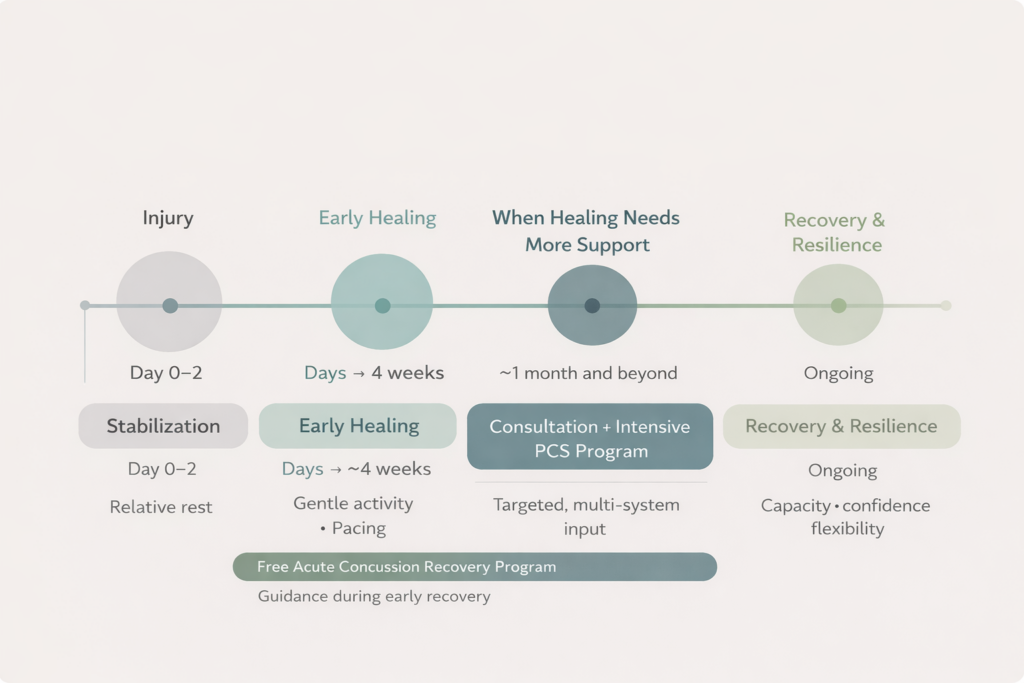
Recovery follows a general pattern—and the kind of support that helps changes as recovery progresses.
Why Waiting Alone Doesn’t Resolve PCS
In the first 24–48 hours after a concussion, relative rest is important. The brain needs a brief period to stabilize.
After that initial phase, research consistently shows that recovery improves when people begin gradual, symptom-guided activity, rather than prolonged inactivity.
Healing doesn’t mean pushing through symptoms. And it also doesn’t mean avoiding all stimulation indefinitely.
When symptoms persist, it’s rarely because the brain needs more rest. More often, it’s because specific systems haven’t been adequately re-engaged.
Prolonged waiting without structure can unintentionally reinforce dysregulation—especially in systems responsible for balance, vision, autonomic control, and cognitive efficiency. This is one reason people with PCS often feel stuck in a cycle of trying to rest their way out of symptoms that don’t resolve.
What Actually Drives Brain Recovery
PCS is not a single-system problem.
It reflects disrupted communication between multiple systems that normally work together seamlessly—vision, balance, movement, cognition, and autonomic regulation.
After a concussion, some areas of the brain become underactive while others overcompensate to maintain function. This compensation can keep a person going, and it’s also exhausting. Tasks that were once automatic now require far more effort.
Recovery depends on neuroplasticity—the brain’s ability to reorganize and form new connections. But neuroplasticity is not activated by inactivity alone. It requires coordinated, appropriately dosed input.
This is why symptom-by-symptom treatment often falls short.
Approaches that engage multiple systems simultaneously—such as multi-sensory integration—help increase blood flow to underactive regions (a process known as neurovascular coupling) and reduce inefficient compensation patterns. Over time, this allows the brain to operate more efficiently rather than working harder just to get through the day.
For a deeper dive into the elements of effective post-concussion treatment, see Post-Concussion Syndrome Treatment: 5 Science-Backed Elements.
Matching Support to the Stage of Recovery
Early recovery and persistent symptoms require different kinds of support.
In the early days and weeks after a concussion, many people benefit from education and structure around pacing, gentle movement, nutrition, sleep rhythms, and gradual re-engagement. This is where guidance—not passivity—helps recovery continue moving forward.
Here is access to our free acute concussion program meant for those early days of concussion recovery.
When symptoms persist beyond approximately one month, this often signals that more targeted, multi-system support is needed.
We typically begin intensive post-concussion treatment at this stage. This timing reflects clinical patterns—not a rigid deadline—and allows us to intervene when the brain is most likely to benefit from coordinated, individualized input. click the link below or here to schedule a free consultation.
Recovery doesn’t stop—it changes. And the kind of support that helps needs to change with it.
So if you’re still struggling weeks or months after a concussion, it doesn’t mean you waited too long or did something wrong. It means your brain is asking for a different kind of help.
And that help is still available.